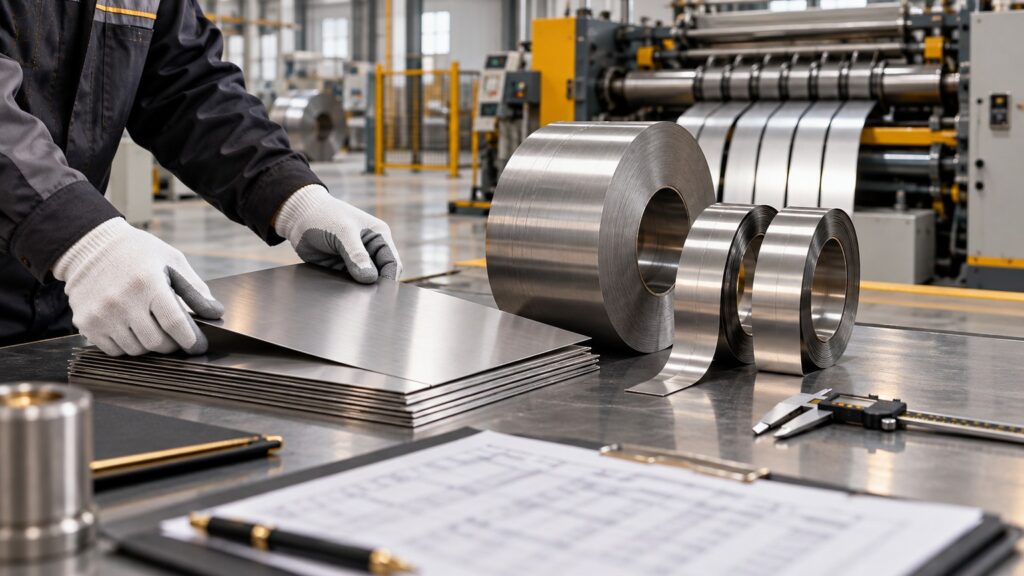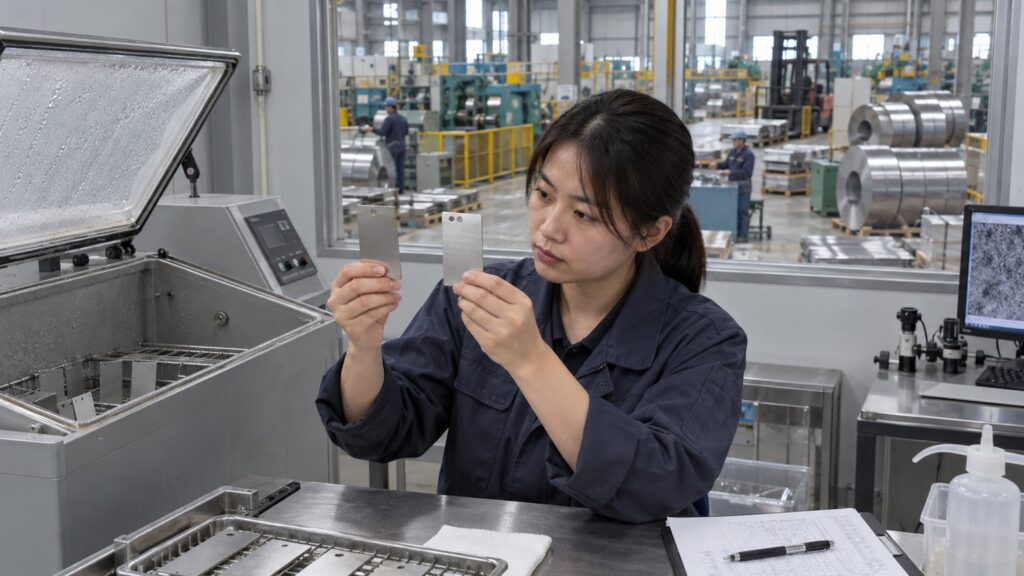
SUS 304 and SUS 304L are among the most widely specified austenitic stainless steels in modern manufacturing. They appear in food-processing equipment, kitchen systems, architectural components, storage tanks, industrial enclosures, heat exchangers, chemical equipment, welded piping, electrical cabinets, transportation components, and thousands of stamped or formed products.
At first glance, the two grades appear nearly identical. They belong to the same chromium-nickel stainless steel family, offer similar general corrosion resistance, can be supplied in comparable surface finishes, and respond to many of the same cutting, forming, polishing, and welding processes.
The letter “L,” however, is not a cosmetic suffix. It identifies a lower-carbon version developed primarily to reduce the risk of sensitization and intergranular corrosion after welding or prolonged thermal exposure within a critical temperature range.
That does not mean 304L is automatically the superior choice for every component. It also does not mean standard 304 will fail whenever it is welded. Modern steelmaking, actual carbon content, product thickness, welding heat input, joint geometry, cooling rate, service environment, surface treatment, and applicable material standard all influence the final result.
The correct purchasing question is therefore not simply:
Is 304L better than 304?
A more useful question is:
Which grade, product form, mechanical-property requirement, fabrication route, and certificate condition will provide the necessary performance for this particular component?
This guide examines that question from the perspective of a stainless steel material supplier and processing partner. It covers composition, weldability, sensitization, corrosion mechanisms, strength, cold forming, cutting, surface finishing, dual certification, industrial applications, procurement requirements, common specification errors, and practical counterexamples.
The Short Answer: What Is the Difference Between 304 and 304L?
The primary metallurgical difference is the maximum permitted carbon content.
Under commonly used specifications, standard 304 may permit carbon content up to approximately 0.08%, while 304L limits carbon to approximately 0.03%. Exact composition limits must always be checked against the applicable standard, edition, product form, and grade designation.
The lower carbon content of 304L reduces the amount of carbon available to combine with chromium during welding or thermal exposure. This lowers the risk of chromium carbide precipitation at grain boundaries and the associated chromium-depleted regions that can become vulnerable to intergranular corrosion.
In practical terms:
- Choose 304 when the component operates in a generally mild environment, welding is limited or carefully controlled, and the specified mechanical properties are satisfied.
- Choose 304L when the component includes significant welding, cannot be solution annealed after fabrication, or will operate in an environment where corrosion near welds would create unacceptable risk.
- Consider dual-certified 304/304L material when the project needs low-carbon chemistry together with mechanical properties satisfying the specified 304 requirements.
- Do not assume 304L offers better resistance to every form of corrosion. Its principal advantage concerns sensitization and intergranular corrosion.
304L does not contain the molybdenum used to improve chloride pitting resistance in 316-series stainless steels. If chloride exposure is the dominant concern, the more relevant comparison may be 304 versus 316 stainless steel.
What Does SUS Mean?
“SUS” is a grade designation commonly associated with Japanese Industrial Standards. SUS304 and SUS304L are therefore JIS designations rather than universal names that automatically cover every stainless steel standard.
Other commonly encountered designations include:
| System | Standard 304 | Low-carbon 304L |
|---|---|---|
| JIS designation | SUS304 | SUS304L |
| ASTM/AISI shorthand | 304 | 304L |
| UNS designation | S30400 | S30403 |
| Common EN designation | 1.4301 | 1.4307 |
| EN symbolic designation | X5CrNi18-10 | X2CrNi18-9 |
These grades are commonly treated as international counterparts, but “counterpart” should not be interpreted as perfectly interchangeable.
Composition ranges, mechanical-property requirements, dimensional tolerances, testing, surface-finish definitions, and certification practices can vary according to the standard and product form.
A purchase order should not say only “304L stainless steel.” It should identify:
- Required material standard
- Grade designation
- Product form
- Applicable standard edition
- Dimensions and tolerances
- Delivery condition
- Surface finish
- Mechanical requirements
- Inspection certificate
- Special testing
- Traceability requirements
For example, cold-rolled stainless steel sheet ordered according to JIS requirements should not automatically be evaluated using mechanical values copied from an ASTM plate specification.
The commercial grade family may be similar, but contractual compliance is determined by the standard stated on the purchase order.
Chemical Composition: Why a Small Carbon Difference Matters
Austenitic 304-series stainless steel depends principally on chromium and nickel.
Chromium supports the formation of the thin, chromium-rich passive surface film responsible for stainless steel’s general corrosion resistance. Nickel helps stabilize the austenitic structure and contributes to ductility, toughness, and manufacturability.
Carbon affects strength and metallurgical behavior during heat exposure. In this comparison, its relationship with chromium is especially important.
The following table presents a simplified comparison based on commonly encountered 304 and 304L requirements. It should be used as an engineering orientation rather than a replacement for the controlling standard or material certificate.
| Element | 304 | 304L | Practical significance |
|---|---|---|---|
| Carbon | Typically ≤0.08% | Typically ≤0.03% | Lower carbon reduces sensitization risk |
| Chromium | Commonly around 18–20% | Commonly around 18–20% | Supports passive-film formation |
| Nickel | Specification-dependent | Specification-dependent | Stabilizes austenite and supports fabrication |
| Manganese | Commonly limited to approximately 2% | Commonly limited to approximately 2% | Influences steelmaking and structure |
| Silicon | Standard-dependent limit | Standard-dependent limit | Used in steelmaking and deoxidation |
| Phosphorus and sulfur | Controlled residual limits | Controlled residual limits | Affect cleanliness and fabrication behavior |
| Molybdenum | Not intentionally added as in 316 | Not intentionally added as in 316L | Neither grade offers 316L-level chloride resistance |
The numerical difference between 0.08% and 0.03% carbon looks small because both numbers are below one-tenth of one percent. Metallurgically, however, this difference can affect how much chromium carbide forms during sensitizing thermal exposure.
A maximum limit is also not the actual carbon content of every shipment.
A heat of standard 304 may have carbon well below its permitted maximum. A material test report may show chemistry satisfying the carbon requirement of 304L even when the original commercial discussion began with 304.
This is one reason dual-certified material exists. Qualification, however, depends on the complete chemistry and mechanical-property results—not carbon alone.
Understanding Stainless Steel Sensitization
Sensitization is a metallurgical condition that can develop when austenitic stainless steel remains within a temperature range that allows chromium-rich carbides to precipitate along grain boundaries.
The often-cited sensitization range is approximately 450°C to 850°C, although the exact range varies among technical references.
Actual behavior depends on:
- Carbon content
- Time at temperature
- Peak temperature
- Heating and cooling rate
- Prior cold work
- Grain structure
- Section thickness
- Welding procedure
- Repeated thermal cycles
- Other alloying elements
During welding, the weld metal itself melts, while the surrounding base material experiences a gradient of lower temperatures.
Part of this heat-affected zone may remain in the sensitizing range long enough for carbon to combine with chromium.
The result is not that the entire component suddenly loses chromium. Instead, chromium carbides can form preferentially at grain boundaries. The immediately adjacent areas become locally depleted in chromium.
If chromium depletion becomes sufficiently severe, those narrow regions may be less able to maintain an effective passive film in a corrosive environment. Corrosion can then propagate along the grain boundaries, producing intergranular attack.
Because the attack follows the microstructure, a surface may appear relatively intact while material around or beneath the grain boundaries loses integrity.
This makes intergranular corrosion potentially serious in vessels, piping, welded tanks, and other components where leakage or loss of section cannot be tolerated.
What Intergranular Corrosion Looks Like in Practice
Intergranular corrosion does not always appear as ordinary orange surface rust.
Possible indications include:
- Preferential attack beside a weld
- A narrow corroded region in the heat-affected zone
- Grain dropping
- A rough or crystalline surface
- Unexpected leakage near welded seams
- Loss of mechanical integrity without uniform surface loss
- Cracking or separation following grain-boundary attack
- Damage revealed during metallographic examination
The environment must be capable of attacking the sensitized region.
Sensitization is the metallurgical condition. Intergranular corrosion is the resulting damage mechanism when that condition encounters a sufficiently aggressive environment.
This distinction helps explain why two nominally identical welded 304 components can have different service histories.
A sensitized area may remain apparently stable in a mild, dry indoor environment but deteriorate after exposure to an acidic process solution, repeated chemical cleaning, condensation, or another aggressive medium.
Conversely, a stain near a weld does not automatically prove intergranular corrosion.
It may result from:
- Weld heat tint
- Free-iron contamination
- Incomplete cleaning
- Crevice corrosion
- Pitting corrosion
- Fabrication residue
- Contaminated rinse water
Failure analysis should identify the actual mechanism instead of assuming that every weld-related stain is caused by sensitization.
How 304L Reduces Sensitization Risk
304L contains less carbon, leaving less carbon available to form chromium carbides during ordinary welding cycles.
This substantially reduces the risk of sensitization and helps preserve corrosion resistance around welded regions.
The technically correct phrase is “reduces the risk”—not “eliminates the risk entirely.”
304L can still underperform when:
- It experiences unusually long thermal exposure
- Welding procedures create excessive heat input
- Multiple weld repairs repeatedly heat the same area
- Heavy oxidation or heat tint is left untreated
- Carbon contamination occurs during fabrication
- The service environment causes pitting or crevice corrosion
- The selected grade is unsuitable for the chemical involved
- Incorrect filler metal or shielding practice is used
- Fabrication introduces embedded carbon-steel particles
- Surface deposits concentrate corrosive chemicals
Low-carbon chemistry is one control within a broader welding and corrosion-management system.
For many normally welded components, 304L can be placed in service without post-weld solution annealing, provided the welding procedure, surface condition, design, inspection, and service environment are acceptable.
That statement is more accurate than saying 304L never requires post-weld treatment.
A construction code, customer specification, critical service condition, or special fabrication route may still require heat treatment, pickling, passivation, corrosion testing, or additional inspection.
Does Standard 304 Always Require Post-Weld Annealing?
No.
Many 304 components are welded successfully without post-weld solution annealing.
Whether sensitization becomes significant depends on:
- Actual carbon content
- Section thickness
- Time at temperature
- Cooling rate
- Joint design
- Welding heat input
- Service environment
- Post-weld surface condition
Thin sheet can cool rapidly after welding. Modern 304 heats may also contain carbon substantially below the maximum permitted limit.
With controlled heat input and an appropriate welding procedure, sensitization risk may remain acceptable for many general applications.
Post-weld solution annealing involves heating stainless steel sufficiently to dissolve chromium carbides and then cooling it rapidly enough to prevent renewed precipitation.
For a large fabricated vessel or assembly, this may be technically difficult, dimensionally disruptive, or economically impractical.
This practical limitation is one reason low-carbon grades became important for welded fabrication. Specifying SUS 304L stainless steel can provide a more manageable route where full solution annealing of the finished assembly is not feasible.
However, 304L should not be used as permission to ignore welding procedure qualification. Heat input, shielding gas, purge quality, filler metal, joint cleanliness, distortion, and weld-oxide removal still affect the finished component.
304 vs 304L Mechanical Properties
Carbon contributes to strength, so specifications may assign different minimum tensile requirements to 304 and 304L.
Under commonly cited ASTM A240/A240M requirements for annealed flat products, 304 is often associated with a higher minimum tensile strength than 304L.
The frequently repeated values of approximately 515 MPa for 304 and 485 MPa for 304L are specification minimums used in certain product contexts. They are not universal measured properties for every coil, sheet, plate, bar, tube, or finished component.
Mechanical requirements vary with:
- Material standard
- Product form
- Thickness
- Delivery condition
- Heat treatment
- Cold work
- Temper
- Test direction
- National designation
Actual mill test results can exceed the specified minimums. A low-carbon heat may satisfy 304L chemistry and also achieve the mechanical properties required for 304, enabling dual certification where permitted.
For engineering design, a value copied from a generic online comparison chart should never replace the specified minimum properties, design-code allowables, or certified test results applicable to the purchased product.
Does Lower Carbon Make 304L Soft?
Not in the simplistic sense often implied by sales articles.
Annealed 304L may have a lower specified minimum tensile strength than standard 304 under some standards, but material behavior depends on much more than carbon:
- Grain size
- Nickel and chromium balance
- Nitrogen
- Cold-reduction history
- Annealing condition
- Strip temper
- Thickness
- Work hardening
- Production route
A coil of work-hardened 304L can be much stronger and harder than annealed 304.
Therefore, the suffix “L” cannot be used by itself to predict cutting force, springback, tool wear, deep-drawing behavior, or finished-part strength.
General Corrosion Resistance: Are 304 and 304L Different?
In the solution-annealed condition, 304 and 304L generally provide similar resistance to many ordinary environments.
Their chromium and nickel systems are comparable, and neither grade contains the intentional molybdenum addition characteristic of 316 and 316L.
The primary corrosion advantage of 304L appears after welding or sensitizing thermal exposure, where its lower carbon content reduces susceptibility to intergranular corrosion.
304L is not inherently a major upgrade for:
- Chloride pitting
- Crevice corrosion
- Marine salt exposure
- Chloride stress-corrosion cracking
- Hydrochloric acid
- Strong reducing acids
- Hot concentrated bleach
- Stagnant seawater
If chloride resistance is the main selection issue, comparing 304 and 316 stainless steel is more relevant than comparing 304 and 304L.
This is especially important in coastal specifications.
Low carbon may help protect welded regions against sensitization-related corrosion, but 304L remains a molybdenum-free grade. It can still develop tea staining, pitting, or crevice corrosion in salt-bearing environments.
For a heavily welded coastal component, the actual material comparison may need to be 304L versus 316L stainless steel—not 304 versus 304L.
Pitting and Crevice Corrosion Are Separate Risks
Pitting is localized attack that penetrates the surface at discrete points.
Crevice corrosion develops in shielded areas where local chemistry changes because oxygen transport is restricted and contaminants accumulate.
Common crevice locations include:
- Overlapping sheets
- Gasketed joints
- Fastener interfaces
- Deposits
- Labels
- Poorly drained folds
- Weld undercut
- Surface defects
- Trapped cleaning chemicals
Lowering carbon from the 304 level to the 304L level does not add the molybdenum needed to produce the characteristic pitting-resistance improvement of 316L.
A welded 304L enclosure installed near the sea may be less susceptible to intergranular corrosion than a sensitized 304 enclosure, but it can still pit beneath chloride deposits.
Material selection should identify the dominant corrosion mechanism rather than treating “corrosion resistance” as one universal property.
Chloride Stress-Corrosion Cracking
Both 304 and 304L are austenitic stainless steels and may be susceptible to chloride stress-corrosion cracking under an unfavorable combination of tensile stress, chloride exposure, and temperature.
Sources of tensile stress include:
- Applied service load
- Residual welding stress
- Cold forming
- Pressing
- Assembly interference
- Local stress concentration
- Thermal cycling
Low carbon does not eliminate chloride stress-corrosion cracking.
If this mechanism is credible, the review may need to consider temperature, chloride concentration, evaporation, residual stress, surface condition, component design, and alternative alloy families.
This is another reason why the statement “304L is more corrosion-resistant” is too broad.
304L is more resistant to sensitization-related intergranular corrosion, but it is not universally superior against every corrosion mechanism.
Weldability: What 304L Actually Improves
Both 304 and 304L are generally considered weldable when suitable procedures and consumables are used.
304L is particularly useful when:
- The assembly contains extensive welded seams
- Section thickness slows cooling
- Multiple welding passes are required
- Post-weld solution annealing is impractical
- The heat-affected zone will face a corrosive process
- Fabrication involves weld repairs
- Long-term weld integrity is important to containment
The selected filler metal must be compatible with the base material, service conditions, mechanical requirements, and welding process.
A low-carbon filler is commonly considered for welded stainless fabrication, but the correct filler cannot be selected from the base-metal name alone.
The welding procedure should address:
- Joint preparation
- Cleanliness
- Tack-welding sequence
- Heat input
- Interpass temperature
- Shielding gas
- Root purge
- Filler metal
- Distortion
- Arc strikes
- Post-weld cleaning
- Inspection and acceptance
A correct 304L purchase order cannot rescue an uncontrolled welding operation.
Heavy-Gauge Components and Multipass Welding
Thicker material generally requires greater total welding energy and may experience slower cooling or multiple thermal cycles.
Adjacent material can therefore spend more time within temperatures where sensitization is possible.
This makes 304L attractive for:
- Heavy-gauge tanks
- Pressure-vessel components
- Structural fabrications
- Thick piping
- Process skids
- Repeated multipass joints
- Assemblies requiring substantial weld repair
However, “heavy gauge” does not establish suitability by itself.
A pressure vessel must satisfy its governing design and construction code. Base-metal grade, allowable stress, filler metal, welding procedure qualification, heat treatment, nondestructive examination, corrosion allowance, and service medium all remain relevant.
304L does not automatically “maintain integrity under high stress and heat” merely because it has low carbon.
Elevated-temperature service may require an assessment of creep, oxidation, phase stability, code allowables, and whether a different grade is more appropriate.
Elevated-Temperature Service: Why 304L Is Not Always the Answer
304L is optimized primarily to reduce sensitization risk in welded or thermally exposed fabrication. It is not automatically the preferred grade for prolonged high-temperature load-bearing service.
Standard 304 or higher-carbon variants may offer advantages where elevated-temperature strength is important. Stabilized grades such as 321 or 347 may be considered where resistance to sensitization during repeated or prolonged thermal exposure is required.
Selection should distinguish among:
- Brief welding heat cycles
- Intermittent elevated-temperature exposure
- Continuous high-temperature operation
- Load-bearing creep service
- Oxidizing furnace conditions
- Thermal cycling
- High-temperature chemical exposure
The existence of an “L” grade should not be interpreted as a universal upgrade.
Lower carbon addresses a defined metallurgical risk while potentially changing other properties or design allowables.
Dual-Certified 304/304L Stainless Steel
Dual certification is common in modern stainless steel supply chains.
A heat may be certified as both 304 and 304L when:
- Its chemistry satisfies the lower-carbon requirements of 304L.
- Its mechanical properties satisfy the applicable requirements for both grades.
- The governing material specification permits the certification.
- The inspection certificate explicitly identifies both grades.
Dual certification can simplify inventory and procurement. A fabricator may receive low-carbon chemistry without surrendering the mechanical-property level required by a 304 specification.
However, procurement teams should avoid several mistakes:
- Do not assume every 304 coil is dual-certified.
- Do not infer dual certification from carbon content alone.
- Do not change the material designation without supporting certification.
- Do not treat 304/304L as a separate alloy with superior properties to both grades.
- Do not assume certification under one standard automatically satisfies another.
- Do not use “dual certified” without reviewing the material certificate.
The correct evidence is an applicable inspection document showing the reported chemistry, mechanical properties, product standard, heat number, and declared grades.
Material Test Reports and Traceability
The terms Material Test Report, Mill Test Report, MTR, Mill Test Certificate, and MTC are sometimes used interchangeably in commercial discussions.
Their precise meaning may depend on the supplier, customer, standard, and certificate system.
For critical purchasing, define the required document instead of relying on an acronym.
A useful material certificate may include:
- Manufacturer
- Heat number
- Coil or plate identification
- Grade
- Product standard
- Chemical analysis
- Mechanical test results
- Dimensions
- Delivery condition
- Surface finish
- Certificate type
- Authorized validation
If an EN 10204 type 3.1 inspection certificate is required, state that requirement during quotation. Do not assume every stock lot includes every possible certificate format.
Physical traceability must also continue after processing.
When a master coil is slit into narrow coils or sheet is cut into blanks, the processor needs a controlled method to transfer heat and lot identification to the resulting packages and documents.
A certificate is useful only when the delivered material can be connected reliably to it.
Precision Slitting: Do 304 and 304L Behave Differently?
It is too simplistic to say 304L is always “kinder” to slitting knives.
Slitting performance depends on:
- Actual hardness
- Tensile and yield strength
- Elongation
- Work-hardening condition
- Thickness
- Width
- Knife clearance
- Knife overlap
- Tool material
- Knife sharpness
- Line tension
- Coil shape
- Burr requirement
- Strip temper
In annealed products with otherwise similar conditions, a particular 304L heat may show somewhat different deformation behavior from a particular 304 heat.
However, this cannot be predicted reliably from the L suffix alone.
For stainless steel slitting and precision processing, the processing team should examine the actual certificate, thickness range, temper, edge requirement, width tolerance, and downstream process.
Critical results include:
- Slit-width consistency
- Burr height and direction
- Edge rollover
- Camber
- Coil build
- Telescoping
- Surface protection
- Traceability
- Packaging stability
When a customer changes from 304 to 304L, production should confirm the process settings through an initial-coil or first-article evaluation rather than assuming that no adjustment is necessary.
Shearing, Blanking, and Laser Cutting
304 and 304L can both be sheared, blanked, punched, or laser cut.
Cut quality depends more heavily on actual mechanical condition, thickness, tooling, and machine settings than on the nominal carbon difference.
For shearing, review:
- Blade clearance
- Blade condition
- Rake angle
- Hold-down pressure
- Part distortion
- Burr
- Squareness
- Protective-film behavior
For punching and blanking, review:
- Punch-to-die clearance
- Hole-to-edge distance
- Tool wear
- Galling
- Lubrication
- Burr direction
- Subsequent bending
- Surface contamination
For laser cutting, review:
- Assist gas
- Heat tint
- Dross
- Edge oxidation
- Protective film
- Downstream welding
- Cleaning requirements
Cutting exposes fresh stainless steel, but a clean surface can reform its passive film in the presence of oxygen.
Problems arise when processing leaves embedded iron, heavy oxide, dross, contaminated lubricant, or geometry that traps corrosive residue.
Cold Forming and Deep Drawing
Both grades offer the ductility associated with 300-series austenitic stainless steels, but forming performance is not controlled by carbon content alone.
Deep-drawing behavior depends on:
- Austenite stability
- Nickel and alloy balance
- Grain size
- Surface finish
- Lubrication
- Blank-holder force
- Die radius
- Punch radius
- Draw ratio
- Material thickness
- Directional properties
- Prior cold reduction
It is unsafe to promise that every 304L coil will deep-draw better than every 304 coil.
For demanding drawn components, buyers should specify the intended operation and critical geometry. Trial material or forming simulation may be more valuable than choosing a grade based on a generic elongation value.
The supplier and fabricator should also agree on protective-film and lubricant compatibility.
A film that protects flat sheet may wrinkle, tear, or transfer adhesive during severe forming.
Springback and Dimensional Control
Springback is affected primarily by the relationship between yield strength, elastic modulus, thickness, bend radius, work hardening, and tool geometry.
Because 304 and 304L can be supplied with different actual strength levels, springback may differ between shipments.
The L designation does not establish one fixed springback value.
A stable fabrication process should monitor:
- Incoming mechanical properties
- Material thickness
- Grain direction
- Bend radius
- Tool wear
- Press settings
- Finished angle
- Flange dimension
- Twist
- Flatness
If a manufacturer changes from one 304 source to dual-certified 304/304L, the chemistry may remain suitable while the actual yield strength shifts enough to affect the bend result.
First-article inspection is therefore appropriate after significant material, temper, or supplier changes.
Work Hardening and Magnetism
Both 304 and 304L are austenitic stainless steels in the solution-annealed condition. Both can work harden during deformation.
Cold rolling, bending, drawing, and stamping may transform part of the austenitic structure into deformation-induced martensite.
This can increase strength and hardness and may make the material somewhat magnetic.
Consequently:
- A magnet is not a reliable grade-identification tool.
- Slight magnetism does not prove that a component is not 304 or 304L.
- Low carbon does not prevent work hardening.
- Actual forming behavior should be evaluated using certified properties and production trials.
Handheld XRF can help verify chromium and nickel composition, but it generally does not measure carbon accurately enough to distinguish 304 from 304L.
Differentiating the two grades may require documentation or a laboratory method capable of analyzing low carbon.
This is a crucial procurement point: XRF may distinguish 304 from molybdenum-bearing 316, but it should not be promoted as a complete field solution for separating 304 from 304L.
Surface Finishing: Will 304 and 304L Look Different?
Under equivalent processing, 304 and 304L can achieve visually similar 2B, BA, No. 4, hairline, brushed, polished, or custom finishes.
An observer usually cannot identify the low-carbon grade by appearance.
Surface appearance depends more on:
- Starting mill finish
- Surface roughness
- Abrasive grit
- Belt condition
- Feed speed
- Applied pressure
- Polishing direction
- Lubrication
- Flatness
- Protective film
- Lighting and viewing angle
For decorative products, establish a physical reference sample or measurable roughness requirement rather than asking only for “hairline” or “No. 4.”
Commercial finish terminology can vary between suppliers and markets.
The stainless steel surface finish guide can help align finish names with processing expectations, but final approval should still consider the customer’s visual criteria and intended fabrication route.
Heat Tint, Pickling, and Passivation
After welding, stainless steel may display yellow, brown, blue, purple, gray, or black heat tint. These oxide colors indicate different degrees of thermal oxidation.
Beneath a substantial heat-tint layer, the near-surface region may be depleted in chromium. This can reduce local corrosion resistance even when the base material is 304L.
Depending on service and specification, remediation may include:
- Controlled mechanical cleaning
- Pickling
- Electrochemical cleaning
- Passivation
- Thorough rinsing
- Surface verification
Pickling and passivation should not be treated as identical processes.
Pickling removes oxide scale and a thin layer of affected metal. Passivation is intended primarily to remove free iron and support the formation of a clean passive surface.
Applying a passivation chemical over heavy heat tint may not provide the same result as properly removing the oxide and affected layer.
The appropriate procedure should consider worker safety, chemical control, environmental regulation, surface finish, component geometry, rinsing, and the final service environment.
Iron Contamination: A Common Cause of Stainless Steel Rust
Fabrication shops frequently process both carbon steel and stainless steel.
Grinding dust, wire brushes, work tables, clamps, lifting equipment, storage racks, and shared abrasives can transfer free iron to stainless surfaces.
The embedded or deposited iron may rust when exposed to moisture, creating orange staining. Customers may then conclude that the stainless steel grade is incorrect.
Preventive practices include:
- Dedicated stainless steel brushes and abrasives
- Clean processing areas
- Segregated storage
- Protected forklift and lifting contact points
- Removal of carbon-steel grinding dust
- Clean gloves and handling equipment
- Appropriate post-fabrication cleaning
Choosing 304L instead of 304 does not solve carbon-steel contamination.
The issue is process control—not the bulk carbon content of the stainless steel.
This is an important counterexample because many reported “stainless steel failures” originate after the material has left the mill or service center.
When to Choose SUS 304
SUS 304 stainless steel remains one of the most versatile stainless steels available.
Typical applications may include:
- Commercial kitchen equipment
- Sinks and counters
- Appliances
- Indoor architectural panels
- General enclosures
- Shelving
- Furniture components
- Decorative trim
- Lightly welded fabrications
- Stamped consumer products
- Food-processing components in compatible environments
- General-purpose brackets and covers
304 may be a practical choice when:
- Welding is limited
- Section thickness permits rapid cooling
- Service conditions are relatively mild
- The actual heat has suitably low carbon
- Post-fabrication treatment is available
- The design does not specifically require 304L qualification
- Mechanical requirements favor the specified 304 condition
The selection must still consider cleaning chemicals, chloride exposure, crevices, operating temperature, and customer standards.
A kitchen appliance in a dry indoor environment and a permanently wet food-processing tank are not equivalent merely because both are described as food-industry applications.
When to Choose SUS 304L
304L is commonly preferred for:
- Welded process tanks
- Welded food-processing equipment
- Chemical equipment in compatible media
- Welded piping
- Cryogenic vessels
- Dairy-processing equipment
- Storage vessels
- Large fabricated enclosures
- Heavy-gauge welded assemblies
- Pharmaceutical utility equipment
- Components where post-weld annealing is impractical
Its advantage is strongest when welded regions must maintain resistance to intergranular corrosion.
However, the grade must still be evaluated against the process medium.
304L is not automatically suitable for every chemical, cleaning solution, pharmaceutical process, or coastal exposure.
For chloride-bearing service, SUS 316L stainless steel may provide a more appropriate starting point. For elevated-temperature exposure, stabilized or heat-resistant grades may deserve consideration.
Food and Beverage Equipment
304 and 304L are widely used in food and beverage facilities because they offer cleanable surfaces, good fabrication characteristics, and compatibility with many food products.
The choice should consider:
- Whether the component is welded
- Product chemistry
- Salt content
- Cleaning chemicals
- Cleaning temperature
- Residue retention
- Surface finish
- Crevices
- Drainage
- Contact time
A lightly welded dry-food conveyor cover may perform well in 304. A welded vessel subjected to repeated cleaning cycles may justify 304L.
A component exposed to warm chloride-bearing brine may require 316L or another alloy despite low-carbon chemistry.
Food-industry use does not automatically prove material suitability. Cleaning conditions can sometimes be more corrosive than the food product itself.
Chemical Tanks and Piping
Chemical equipment is frequently listed as a standard 304L application, but “chemical service” is too broad to support a responsible material decision.
Engineers need:
- Chemical identity
- Concentration
- Temperature
- Contaminants
- Aeration
- Flow or stagnation
- Vapor condensation
- Cleaning process
- Pressure
- Expected upset conditions
304L can be a useful welded-fabrication grade in compatible chemical environments. It can also fail rapidly in an incompatible acid or chloride solution.
The low-carbon designation addresses sensitization. It does not create universal acid resistance.
Where process containment is critical, material selection should involve the equipment designer, corrosion specialist, applicable design code, welding engineer, and end user.
Architectural and Coastal Components
For indoor architectural panels, elevators, trim, and decorative components, 304 is often sufficient when the environment is controlled.
In coastal locations, grade selection becomes more complicated.
Airborne chlorides can accumulate on sheltered surfaces and cause tea staining or pitting. Welding adds another potential vulnerability, but low carbon does not compensate for inadequate pitting resistance.
Possible decisions include:
- 304 for controlled inland interiors
- 304L for heavily welded components in otherwise suitable environments
- 316L for improved chloride resistance
- Higher-alloy materials for severe marine exposure
- Design changes to improve washing and drainage
- Regular maintenance to remove salt deposits
A coastal specification that changes 304 to 304L but ignores molybdenum, finish, drainage, crevices, and cleaning may solve the wrong problem.
Pressure Vessels
Pressure-vessel material selection must comply with the governing construction code and approved material specification.
304L may be selected for welded vessels because its low carbon reduces sensitization risk.
Nevertheless, the complete engineering package must address:
- Code-approved material
- Design temperature
- Allowable stress
- Corrosion allowance
- Welding procedure qualification
- Welder qualification
- Filler metal
- Nondestructive examination
- Post-weld treatment
- Impact or toughness requirements
- Pressure testing
- Material traceability
A website comparison cannot authorize substitution in a coded vessel.
Any substitution between 304, 304L, or dual-certified material must be approved through the project’s engineering and quality process.
Counterexample 1: Choosing 304L for a Chloride Problem
A manufacturer discovers pitting on 304 equipment and assumes that replacing it with 304L will solve the problem.
The replacement component is fabricated in 304L but exposed to the same warm chloride deposits. Pitting returns because carbon content was not the controlling factor.
The investigation should have considered:
- Chloride concentration
- Temperature
- Evaporation
- Deposits
- Crevices
- Cleaning
- 316L or higher-alloy alternatives
The lesson is straightforward: 304L improves resistance to sensitization-related intergranular corrosion, not every type of localized corrosion.
Counterexample 2: Buying 304L but Ignoring Heat Tint
A welded 304L tank is delivered with dark weld oxidation and no appropriate post-weld cleaning. Corrosion begins near the welds.
The purchaser argues that 304L should not corrode after welding.
The grade may have been appropriate, but the surface condition and fabrication controls were not.
Low carbon does not replace welding control, oxide removal, rinsing, and inspection.
Counterexample 3: Assuming 304L Is Always Weaker
A designer rejects dual-certified 304/304L because a comparison chart lists a lower minimum tensile strength for 304L.
The supplied material’s certified mechanical results actually meet the required 304 values as well as 304L chemistry.
Specification minimums and actual certified properties are not the same. Review the complete material certificate before deciding.
Counterexample 4: Using XRF to Approve 304L
Receiving inspection uses handheld XRF to check alloy content.
The result is consistent with a chromium-nickel 304-family alloy, so the inspector approves it as 304L.
Most handheld XRF instruments cannot measure the low carbon level required to distinguish 304L from 304.
Document traceability or an appropriate laboratory carbon-analysis method is still required where low-carbon verification matters.
Counterexample 5: Assuming 304L Is Easier to Cut
A purchasing team changes to 304L expecting lower tool wear.
The new coil arrives in a harder cold-worked condition and creates more burr and tool load than the previous annealed 304.
Cutting performance depends on actual hardness, strength, temper, thickness, tooling, and process settings—not the L suffix alone.
Counterexample 6: Treating Dual Certification as Automatic
A buyer orders 304 and later requests documents showing 304/304L because the customer’s drawing has changed.
The original certificate lists only 304, or the mechanical and documentation requirements do not support dual certification.
Certificate requirements and permitted grade designations must be agreed upon before ordering.
Does 304L Cost More Than 304?
Not necessarily.
The market price difference between 304 and 304L depends on:
- Mill production route
- Regional availability
- Order volume
- Product form
- Thickness
- Width
- Surface finish
- Certificate requirements
- Stock status
- Processing requirements
- Delivery schedule
Modern refining processes can produce low-carbon chemistry efficiently, and many flat products are supplied with dual 304/304L certification.
In these cases, there may be little or no meaningful base-material premium.
A special 304L dimension, finish, origin, certificate, or small order may still cost more because of availability and production scheduling rather than carbon removal alone.
The claim that 304L is always more expensive because AOD or VOD refining consumes more energy is too simplistic. Current pricing should be confirmed through an actual quotation.
The more important commercial comparison is total installed cost, including:
- Material price
- Fabrication yield
- Welding
- Heat treatment
- Cleaning
- Inspection
- Rework
- Qualification
- Maintenance
- Downtime
- Failure consequences
How to Specify 304 or 304L Correctly
A professional material specification should include more than the grade name.
Governing Standard
Identify whether the material must comply with JIS G 4305, ASTM A240/A240M, EN 10088, or another relevant standard.
Product Form
State whether the order is for:
- Coil
- Slit coil
- Strip
- Sheet
- Plate
- Precision blank
- Tube
- Bar
Requirements differ among product forms.
Grade and Certification
State SUS304, SUS304L, 304, 304L, or approved dual certification.
Do not combine designations without defining the controlling standard.
Dimensions and Tolerances
Specify:
- Thickness
- Thickness tolerance
- Width
- Width tolerance
- Length
- Flatness
- Camber
- Squareness
- Coil inside diameter
- Coil weight
Surface Finish
Specify 2B, BA, No. 4, hairline, or another defined finish.
For decorative work, use an approved physical sample.
Mechanical Properties
State whether standard annealed properties are sufficient or whether special yield strength, tensile strength, elongation, hardness, or temper is required.
Edge Condition
For slit strip or cut blanks, define:
- Mill edge or slit edge
- Burr limit
- Burr orientation
- Deburring
- Rounded edge where required
Documentation
State the required material certificate, heat traceability, inspection level, and positive-material-identification requirements.
Intended Fabrication
Inform the supplier whether the material will be:
- Deep drawn
- Roll formed
- Bent
- Stamped
- Laser cut
- Welded
- Polished
This allows processing risks or conflicting requirements to be identified before production.
Procurement Decision Matrix
| Project condition | 304 | 304L | Additional review |
|---|---|---|---|
| Dry indoor component with minimal welding | Strong candidate | Also suitable | Compare availability and properties |
| Extensively welded tank in compatible service | Possible with controls | Often preferred | Confirm welding and cleaning |
| Heavy multipass welds without solution annealing | Higher sensitization concern | Usually preferred | Review thickness and heat input |
| Chloride-rich coastal environment | Limited margin | Limited pitting improvement | Compare 316L or higher alloys |
| High-temperature load-bearing service | May be considered | Not automatically preferred | Review 304H, 321, 347 or other grades |
| Deep-drawn component | Often suitable | Often suitable | Trial the actual coil and condition |
| High-strength cold-worked strip | Available by condition | Available by condition | Specify mechanical properties |
| Low-carbon chemistry plus 304 strength requirements | Not established by name | May require dual certification | Review the certificate |
| Decorative polished panel | Suitable | Suitable | Finish and visual sample dominate |
| Coded pressure equipment | Project-specific | Project-specific | Follow the governing design code |
Questions to Ask Your Stainless Steel Supplier
Before placing an order, ask:
- Which material standard and grade will appear on the certificate?
- Is the material single-certified or dual-certified?
- What are the actual carbon, chromium, and nickel results?
- Which mechanical-property requirements are certified?
- Is the material annealed or supplied in a cold-worked temper?
- What thickness and width tolerances apply?
- What finish and protective film are available?
- Can heat-number traceability be maintained after slitting or cutting?
- What burr, camber, flatness, and edge controls can be provided?
- Is the material suitable for the intended welding, forming, or polishing route?
- What information must be confirmed before quotation?
- Are special certificate or origin requirements available?
These questions produce a more reliable result than asking only for “the price of 304L.”
How Genn-Hann Supports 304 and 304L Projects
Genn-Hann Stainless Steel Enterprise Co., Ltd. supplies and processes stainless steel coil, strip, and sheet for manufacturers.
Our technical and commercial discussions can cover:
- SUS 304 stainless steel
- SUS 304L stainless steel
- Coil and sheet availability
- Precision slitting
- Custom shearing and cutting
- Width and thickness requirements
- Surface finishing
- Protective film
- Packaging
- Certificate requirements
- Downstream forming or welding needs
Our role is to supply and process material according to agreed technical and commercial requirements.
Final component design, welding qualification, pressure rating, corrosion suitability, regulatory approval, and finished-product certification remain the responsibility of the relevant manufacturer, engineer, testing organization, and end user.
For a technical discussion or quotation, provide the drawing, applicable standard, grade, product form, thickness, width, finish, mechanical requirements, certificate type, fabrication route, annual volume, and service environment through the Genn-Hann contact page.
Frequently Asked Questions
Can 304L replace 304?
Often, but not automatically.
304L may be substituted when its chemistry, mechanical properties, product standard, design requirements, and applicable code satisfy the project.
If the design relies on a specific minimum strength, allowable stress, or certification, an engineer must verify the substitution.
Dual-certified 304/304L can simplify the decision when the certificate demonstrates compliance with both grade requirements.
Can 304 replace 304L?
Not without approval.
If the drawing or specification requires 304L, standard 304 cannot be substituted merely because both grades look similar.
The low-carbon requirement may have been selected to control sensitization in a welded component.
Review actual chemistry, welding requirements, applicable code, service environment, and customer approval before changing the grade.
Does 304L Never Suffer Intergranular Corrosion?
No material should be described with an absolute guarantee.
The lower carbon content of 304L substantially reduces sensitization risk during ordinary welding. However, prolonged thermal exposure, contamination, improper welding, severe service, or other metallurgical conditions can still produce problems.
Is 304L Better for Coastal Applications?
Not necessarily.
304L offers an advantage over 304 where weld sensitization is the controlling risk. It does not contain molybdenum and therefore does not provide the chloride-pitting resistance normally associated with 316L.
For coastal exposure, compare 304L with 316L and consider salt deposition, rain washing, surface finish, crevices, drainage, maintenance, and design life.
Does 304L Look Different After No. 4 or Hairline Polishing?
Normally, no visible grade distinction exists when both materials receive the same controlled finishing process.
Appearance is influenced more by starting finish, abrasive, grit, belt condition, pressure, feed speed, grain direction, and protective film.
Is 304L Always Softer and Easier to Cut?
No.
Actual hardness, tensile strength, yield strength, temper, thickness, cold work, and tooling conditions govern cutting behavior.
A cold-worked 304L strip can be harder than annealed 304.
Can Handheld XRF Distinguish 304 From 304L?
Usually not by itself.
XRF can identify major alloying elements such as chromium and nickel, but it normally cannot measure low carbon accurately enough to prove whether the material satisfies the 304L carbon limit.
Use traceability, certification, or an appropriate carbon-analysis method.
What Does Dual-Certified 304/304L Mean?
It means the certified material satisfies the applicable chemistry and mechanical-property requirements for both 304 and 304L under the stated material specification.
The material certificate must explicitly support the dual designation. It should not be assumed merely because the measured carbon content is low.
Does 304L Require Post-Weld Passivation?
The required surface treatment depends on heat tint, contamination, service environment, customer specification, and fabrication process.
Clean 304L can reform a passive film naturally, but heavy heat tint or embedded iron may require qualified cleaning, pickling, or passivation.
Passivation alone should not be used to conceal inadequate weld-oxide removal.
Which Grade Should Be Used for a Welded Food-Processing Tank?
304L is frequently selected for welded food equipment, but the correct grade depends on product chemistry, salt content, cleaning agents, temperature, surface finish, drainage, and applicable hygienic requirements.
Chloride-bearing or aggressive cleaning conditions may justify 316L or another alloy.
Conclusion: Choose the Complete Material Requirement, Not Just the Letter L
The difference between SUS 304 and SUS 304L is technically meaningful, but it should not be exaggerated.
304L’s lower carbon content reduces susceptibility to sensitization and intergranular corrosion after welding.
This makes it a practical choice for many welded tanks, vessels, piping systems, food-processing components, chemical equipment, and heavy fabricated assemblies.
Standard 304 remains an effective material for general fabrication, architectural products, kitchen equipment, enclosures, stamped parts, and numerous applications where exposure and welding conditions are suitable.
The decision cannot be reduced to “304 is stronger” or “304L is more corrosion-resistant.”
The engineering reality is more precise:
- Carbon content primarily changes sensitization behavior.
- Mechanical properties depend on the standard, product form, and delivery condition.
- 304L does not provide 316L-level chloride resistance.
- Both grades require appropriate welding and surface treatment.
- Cutting and forming behavior cannot be predicted from the L suffix alone.
- Dual certification must be demonstrated by the material certificate.
- The applicable standard and actual service environment govern the final selection.
A reliable order connects grade, standard, product form, dimensions, tolerances, finish, mechanical properties, certificate requirements, fabrication route, and end-use environment.
References
Alleima. (n.d.). Sanmac® 304/304L bar and hollow bar: Material datasheet. Retrieved September 12, 2026, from https://www.alleima.com/en/technical-center/material-datasheets/bar-and-hollow-bar/bar/sanmac-304304l/
Aperam. (n.d.). 304L–1.4307 austenitic stainless steel. Retrieved September 12, 2026, from https://www.aperam.com/product/304l-1-4307/
ASTM International. (2026). ASTM A240/A240M-26: Standard specification for chromium and chromium-nickel stainless steel plate, sheet, and strip for pressure vessels and for general applications. https://doi.org/10.1520/A0240_A0240M-26
ASTM International. (n.d.). ASTM A262: Standard practices for detecting susceptibility to intergranular attack in austenitic stainless steels. Retrieved September 12, 2026, from https://www.astm.org/a0262.html
International Organization for Standardization. (1998). ISO 3651-2:1998—Determination of resistance to intergranular corrosion of stainless steels—Part 2: Ferritic, austenitic and ferritic-austenitic stainless steels. https://www.iso.org/standard/24949.html
World Stainless Association. (n.d.). Categories, grades and product forms. Retrieved September 12, 2026, from https://worldstainless.org/about-stainless/what-are-stainless-steels/categories-grades-and-product-forms/
World Stainless Association. (n.d.). Surface treatment. Retrieved September 12, 2026, from https://worldstainless.org/about-stainless/process-and-production/surface-treatment/
Important Product Scope Notice
Genn-Hann Stainless Steel Enterprise Co., Ltd. is a stainless steel material supplier and precision processing service provider.
Available products and services may include stainless steel coil, strip, sheet, CSP material, coated material, slitting, cutting, and surface processing, subject to quotation and order confirmation.
Genn-Hann does not design or certify customers’ finished pressure vessels, tanks, piping systems, food equipment, structural components, or other completed products.
Final grade selection, engineering design, welding procedure, corrosion suitability, regulatory compliance, inspection, and finished-product certification must be confirmed by the responsible manufacturer, engineer, testing organization, end user, and authority having jurisdiction.